1. The Trend Report
What Separates the Tiers
Shape is the first fork in the road. Round rackets carry weight closest to the handle, are the most forgiving on off-centre contacts, and are what every genuine beginner's guide recommends. Diamond-shaped rackets shift weight toward the head for maximum power, but they reward players who already generate consistent racket-head speed and punish everyone else with a smaller, less forgiving sweet spot. Teardrop sits between the two, offering a compromise that still leans toward players who can produce some of their own power.
Core material follows the same logic. Soft EVA foam, standard in beginner and control rackets, cushions mishits and keeps the ball playable even off-centre. Harder EVA and foam cores, common in power-oriented advanced frames, transfer more energy into the ball but transfer more shock back into the player's arm on a bad contact. A beginner's swing is not consistent enough to benefit from that extra stiffness; it mostly adds discomfort and inconsistency.
Carbon layup is the part most buyers never think to ask about. A 3K carbon weave flexes more and suits control-focused rackets. 12K and 18K weaves are stiffer, more direct, and generally reserved for advanced and pro-level frames, the kind Bullpadel and Nox put their sponsored players' names on. That is the material difference behind a £300 price tag, and it is designed for a problem most club players do not have.
The £300 racket isn't overpriced. It's simply built for a problem most buyers don't have yet.
2. The Numbers
£250-400+
Premium and pro-level price bracket. These frames are built for elite technique, not for learning the game.
Budget
£20-£50: absolute first-timers. Decathlon's Kuikma range covers this whole bracket.
Beginner sweet spot
£55-£100: Bullpadel Indiga CTR/PWR, Adidas Drive 3.4, Head Zephyr Pro. All round-shaped, soft EVA.
Improving intermediate
£100-£200: slightly stiffer builds, still largely round or teardrop shaped.
Premium and pro
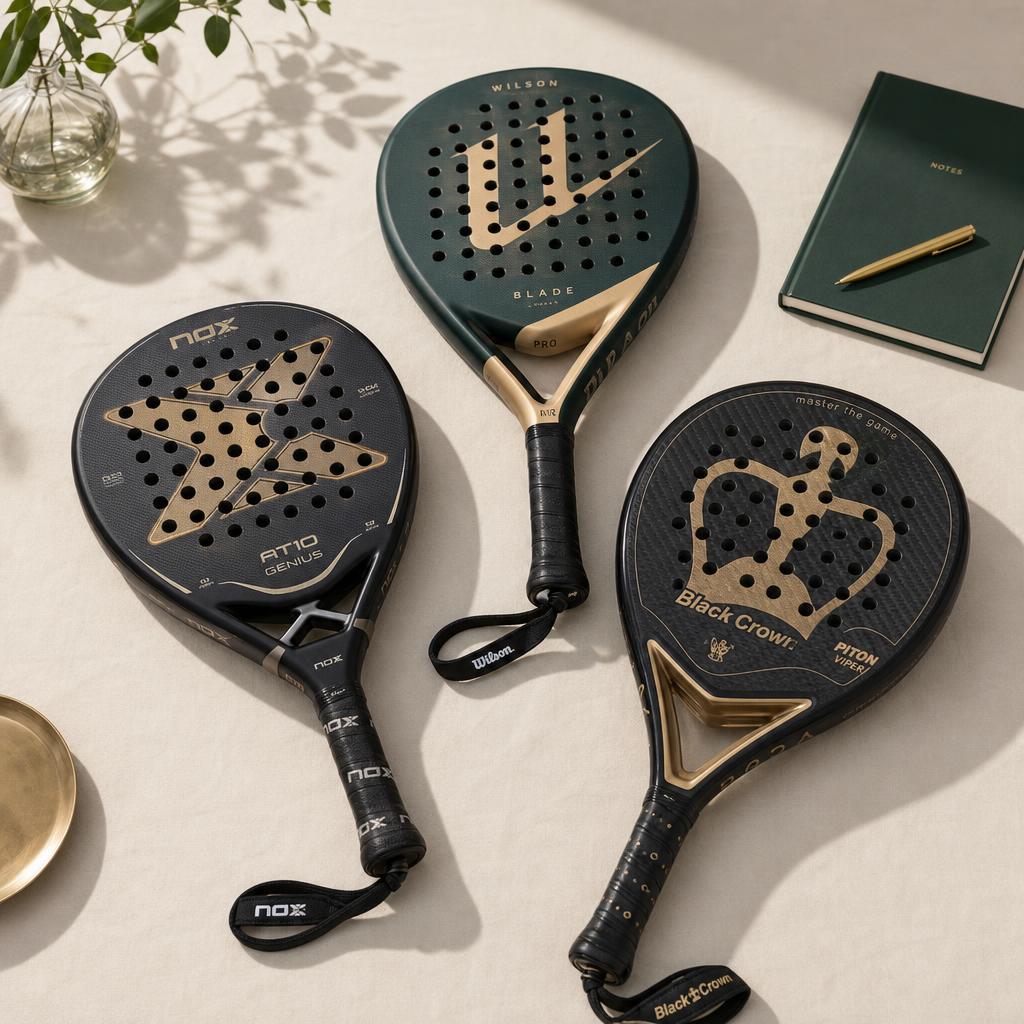
£250-£400+: Bullpadel Vertex, Adidas Metalbone and Adipower, Head Extreme Pro, Nox AT10. Diamond shapes, 12K-18K carbon.
The false bargain
Last season's £300 flagship discounted to £150 is still a stiff, head-heavy pro frame. The discount reflects demand, not suitability.
3. The Business Model / Opportunity
The Real UK Price Map
The named pro signature lines tell you what each brand's flagship frame is built around. Arturo Coello's Head line, Juan Lebron's Babolat Viper, Juan Tello's Bullpadel Vertex, and Agustin Tapia's Nox AT10 are all elite, diamond-leaning power frames built for players who already generate their own racket speed. Buying an entry-level version of one of these lines can still leave a club player with a frame that fights their technique rather than helps it.
UK retailers flag one recurring mistake: last season's flagship pro model, discounted from £300 to £150, looks like an obvious bargain and almost never is. It is still a stiff, heavy, head-heavy racket built for professional-level technique. The discount reflects that it is genuinely hard to sell to anyone else, not that it is a deal. The honest buying advice converging across UK specialists is to spend £65-100 on a round-shaped, soft-EVA beginner frame for at least the first season, and upgrade only once mishits become rare enough that a stiffer, less forgiving frame would genuinely be rewarded rather than punished.
Operator Takeaway: The £300 racket is not overpriced. It is simply built for a problem most buyers do not have yet: generating power a beginner's swing cannot produce, at the cost of forgiveness a beginner's technique still badly needs. Start with control and forgiveness, then buy power once you can actually use it.
4. Quick Hits
Shape hierarchy
Round is forgiving, diamond is power, teardrop sits between. Beginners should almost always start round.
Core logic
Soft EVA cushions mishits; hard EVA and foam transfer more energy but more shock back into the arm.
Carbon layup
3K carbon flexes for control; 12K-18K carbon is stiffer and generally reserved for advanced frames.
The trap
A discounted £300 pro model at £150 is still a pro model. The discount reflects demand, not suitability.
5. The Takeaway
Spend on Technique First, Carbon Later
Feet, reading the bounce, and learning to use the walls decide early-stage games, not the frame in your hand. That is not marketing copy talking a beginner down to a cheaper product. It is the near-unanimous position across independent UK padel retailers and review sites in 2026. The £300 racket will still be there in a season, and it will make far more sense once your swing can actually take advantage of it.